Linden Flower for Stress: A Tree with a Long Reputation
Linden flower for stress has been a European household staple for centuries, and the appeal is easy to understand: it settles the nerves without flattening you.
The herb comes from the flowers and papery bracts of the linden tree, known botanically as Tilia. Several species work interchangeably, mainly Tilia cordata (small-leaved lime), Tilia platyphyllos (large-leaved lime), and their hybrid Tilia x europaea. In North America people usually call the tree basswood. Britain knows it as lime, though it shares nothing with the citrus fruit.
A Two-Week Harvest Window
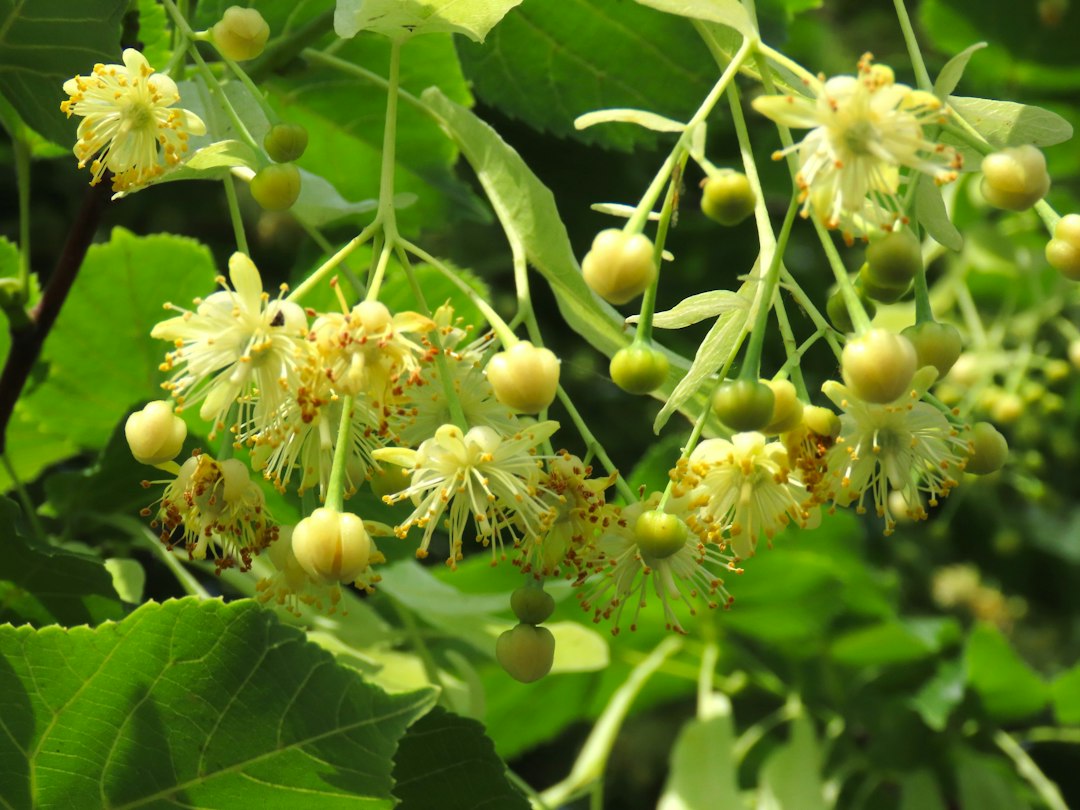
Linden trees are hard to miss in midsummer. They grow tall, sometimes past 30 metres, with broad heart-shaped leaves and a dense canopy. Then, for about two weeks in June or July, the whole tree fills with small pale-yellow flowers. Each cluster hangs from a ribbon-like bract that works as a tiny sail when the seed eventually drops. Harvesters gather flower and bract together, because both go into the finished herb.
Here’s why that matters: the window is short. Pickers must catch linden at peak bloom and dry it quickly in shade, or the delicate aroma disappears. As a result, good linden smells noticeably sweet and looks pale gold. Poor linden smells like hay.
The Tree of the Village Square
Traditionally, this herb sat at the gentle end of the European dispensary, mild enough for children and elders alike. Across France, Germany, Austria and much of Eastern Europe, tilleul or Lindenblütentee was the evening drink for restlessness, a tense day, or the first shiver of a cold. Beekeepers valued the tree too, since linden honey ranks among the most prized in Europe.
The tree itself carried real cultural weight. Village councils across Germanic Europe often met beneath a linden, which people regarded as the tree of justice and of community gathering. That role says something about how the plant came across to them: steady, sheltering, and dependable rather than dramatic.
Inside the Blossom: Properties and Active Constituents
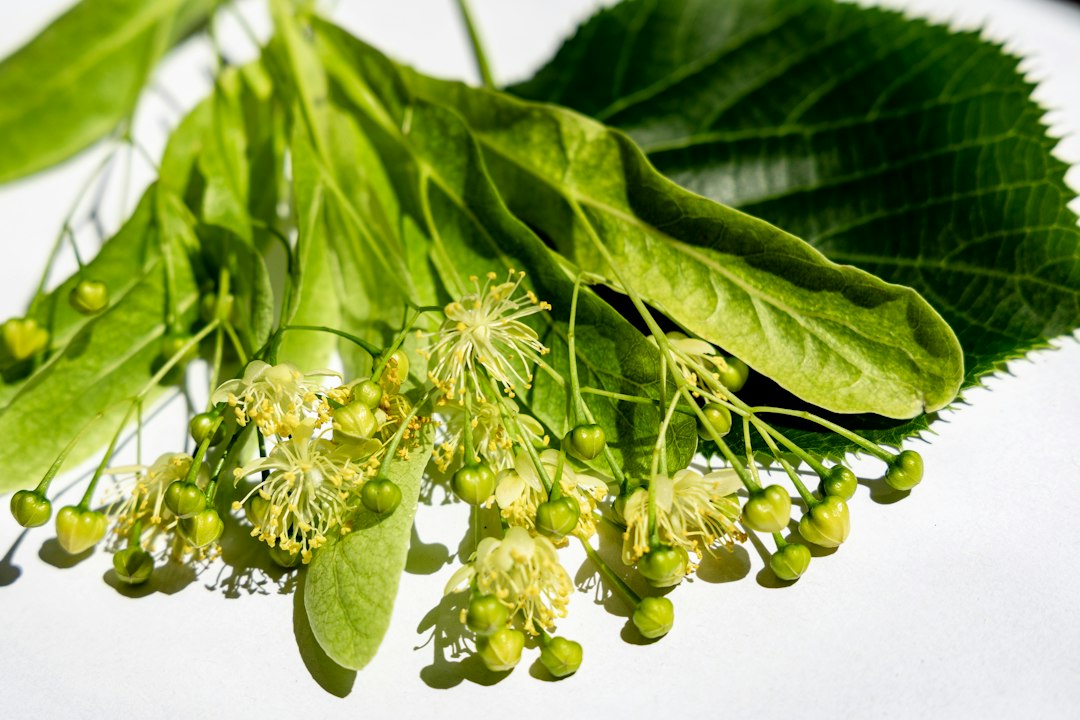
Flower and bract are harvested together.
Linden’s reputation rests on three groups of compounds: flavonoids, mucilage, and volatile oils. The flavonoids, including quercetin, kaempferol and tiliroside, account for most of the antioxidant and vessel-toning activity. Meanwhile the mucilage gives the tea its faintly slippery texture and its soothing effect on irritated tissue. Volatile oils, farnesol especially, carry the honeyed scent and contribute to the relaxing quality.
So what does that mean in practice? Herbalists classify linden as a relaxing nervine, a diaphoretic, and a mild hypotensive. Those three actions overlap more than they first appear.
Three Overlapping Actions
As a nervine, linden is traditionally associated with tension that shows up in the body: a clenched jaw, a quick pulse, the kind of evening where nothing will stand down. People reach for linden flower for stress precisely because it takes the edge off without the heaviness of a stronger sedative.
As a diaphoretic, it encourages gentle sweating. European practice therefore pairs it with elderflower and chamomile at the onset of a fever, since warmth and circulation to the skin are thought to help the body work through it. Our guide to elderberry for cold and flu covers the same seasonal ground.
The cardiovascular angle is the least familiar, yet it runs deep in tradition. Herbalists have long used linden for mildly raised blood pressure and for palpitations tied to anxiety rather than to heart disease. Hawthorn is its usual partner, and practitioners frequently combine the two. If that interests you, our article on hawthorn berry for heart health goes further.
What the Research Says So Far
Evidence remains modest, although it is growing. Reviews of the genus report antioxidant, anti-inflammatory and mild anxiolytic activity in laboratory and animal models, and the European Medicines Agency recognises linden flower as a traditional herbal medicine for the relief of mild stress symptoms and as an aid to sleep. Still, human trials stay limited. Most of what herbalists rely on therefore comes from long, consistent traditional use rather than from large clinical studies.
How to Use Linden Flower for Stress at Home
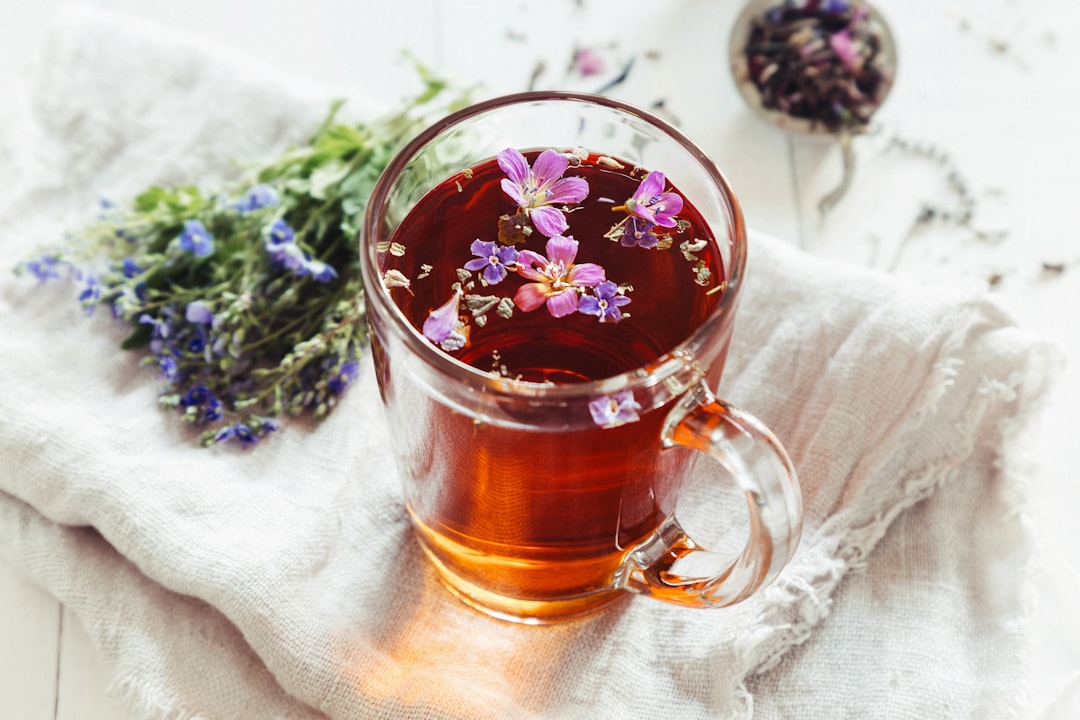
Cover the cup while linden steeps.
Tea is the classic preparation, and for good reason. Both the mucilage and the volatile oils come out well in hot water, so a simple infusion captures nearly everything the flower has to offer. Use a heaped tablespoon of dried flower per cup, cover it while it steeps, and give it eight to ten minutes. Covering matters, because the aromatics otherwise escape with the steam.
The flavour is mild, faintly sweet, and a little floral. Most people drink it plain. However, it blends easily with chamomile, lemon balm or elderflower when you want something more layered.
Linden Flower for Stress: Tea or Tincture?
Tincture is the other common form. A tincture works faster, keeps for years, and makes the amount consistent every time, which suits anyone who would rather not brew a pot each evening. Our Linden tincture uses flower and bract in a 1:5 ratio, the same classic method we apply across the range.
Many people try it in the hour before bed, either as a last cup of tea or a few drops in water. Others save it for specific moments instead: a tense afternoon, a long flight, the first day of a cold. Both patterns appear throughout the traditional literature, so pick whichever fits your routine.
Why Freshness Matters Here
Linden loses quality faster than tougher roots and barks, so age and storage matter a great deal. We buy from suppliers who dry in shade and ship promptly, then we keep the material sealed and away from light. Good linden still smells sweet when you open the bag. If it smells of nothing, it will taste of nothing.
Finally, the usual caution. Linden is generally regarded as gentle, yet anyone taking blood pressure or diuretic medication, anyone pregnant, and anyone managing a known heart condition should speak with a qualified practitioner first. We make no dosing recommendations, and this article is educational rather than prescriptive.
FAQ
- Superior Sourcing: Our herbs are sourced from all over the world to avoid seasonal fluctuations in availability, keeping herbs accessible. Our suppliers meet strict standards that ensure top quality herbs, most of which are organic, wildcrafted, sustainably grown, or grown using permaculture. We support local farmers and grow many of our own herbs.
- Superior Processing: Our tinctures are made using the classic tincturing method. The tinctures are made in a 1:5 ratio which allows for the optimal extraction of the herb. The alcohol percentage is strictly controlled depending on the herb and part of the plant that is used.
- Superior Selection: We take pride in our growing selection of over 300 individual herbs. If we don’t carry the herb you’re seeking, we can likely track it down for you.
- Superior Quality Control: Our tinctures are thoroughly tested by a third-party lab and with an organoleptic evaluation by our team of herbalists prior to final bottling.
- Superior Price: Our tinctures are more cost-effective than other tinctures on the market. With an eye towards efficiency, we keep our costs low by maintaining good relationships with our wide network of suppliers and ordering herbs in bulk quantities.
- We Care About the Environment: We repackage materials that are shipped to us (so don’t be surprised if our packages look different from time to time!). We recycle or reuse materials whenever possible. We turn the cardboard we receive from other suppliers into packing material. We donate to avoid waste to groups like Naturopaths Without Borders. Our workforce almost completely uses public transportation or bikes. We are powered using 100% renewable energy through Bullfrog Power.
- We Donate To Charity: We support many causes that make the world better. We donate a portion of our profits or products. These include charities that support environmental and natural sustainability.
Set up an online account and order through the website. If you don’t have an account and place an order, one will be created for you.
Click here to subscribe to our mailing list.
Our products are made in Toronto, Ontario, Canada by a team of Herbalists and Naturopathic Doctors. The herbs and ingredients we use to make our products are sourced both locally and globally to keep herbs accessible and sustainable.
The majority of our herbs are certified organic, sustainably wildcrafted, or come from small-scale local organic farms that do not yet have organic certification. We always do our best to provide organic herbs in your formulas. We work with a variety of suppliers to keep costs low.
Although most of our products do not contain gluten, we do not have gluten-free certification for our production facility. Feel free to ask about any specific products and we’ll share whatever information we have available.
For liability and regulatory reasons, we don’t make any claims as to how our herbs should be used, including dosing recommendations. Please review our disclaimer, as well as our terms and policies.