Holy Basil for Stress Relief: What Tulsi Is and Where It Comes From
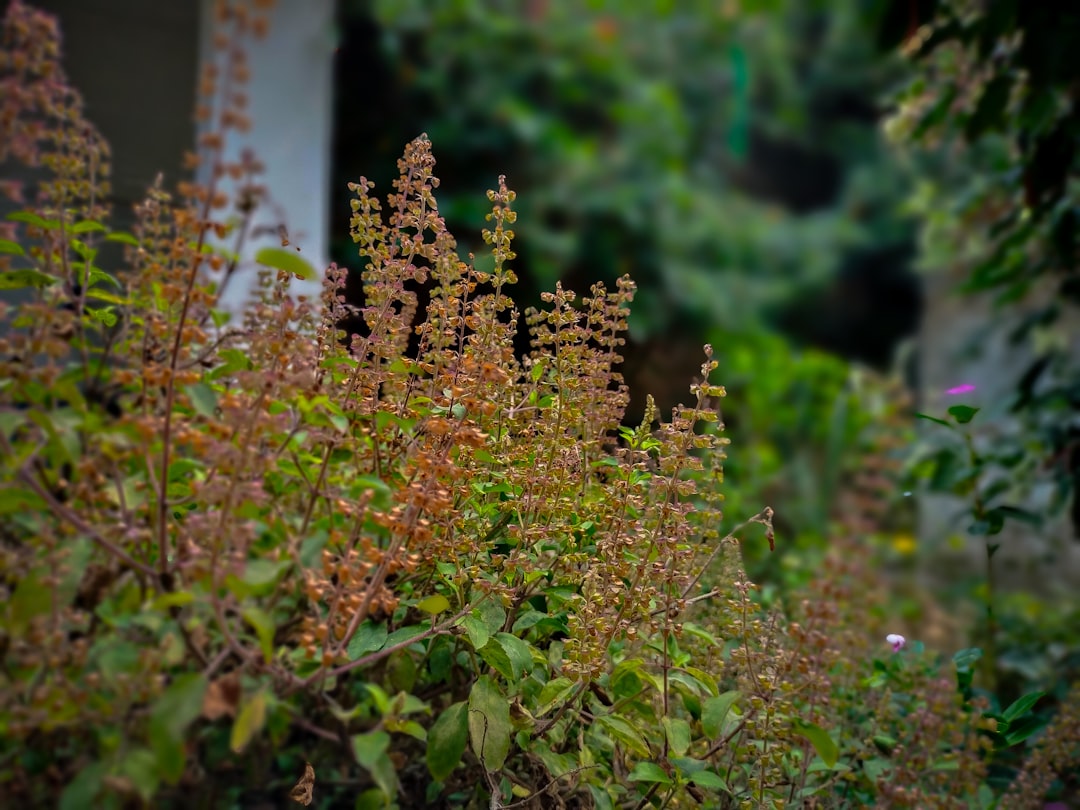
Holy basil (Ocimum sanctum), known in Ayurveda as tulsi.
Holy basil for stress relief sits at the heart of one of the oldest continuous herbal traditions on earth. In India, families have grown tulsi tincture source plants on doorsteps and temple courtyards for more than 3,000 years. Ayurvedic texts treat the plant as sacred. The leaf is the part we use, picked fresh and either steeped as tea or extracted into tincture.
A Quick Botanical Profile of Tulsi
The Latin name is Ocimum sanctum (sometimes written Ocimum tenuiflorum). It sits in the mint family (Lamiaceae) alongside basil, rosemary, and oregano. Tulsi grows as a small, fragrant shrub. Its leaves are soft green or purple-tinged, and the tiny flowers are lavender-pink. Crushed leaves smell sharp and clove-like with a hint of pepper. That scent is a useful tell when you check quality.
Krishna vs Vana: Choosing Holy Basil for Stress Relief
Here’s why that matters: two main types of tulsi sell in North America, and they are not interchangeable. Krishna tulsi has dark purple leaves and a stronger, spicier profile. Vana tulsi grows wild in the Himalayan foothills. It tends to be milder and more aromatic. Both varieties act as adaptogens. Herbalists often blend them for a fuller effect.
Ayurvedic practitioners class tulsi as a Rasayana. That term loosely translates to a tonic that supports longevity and resilience. In other words, tulsi was never used as a quick fix. People took it daily, the way someone today might keep a small bottle of tincture on the kitchen counter and reach for it through a long week. The plant has earned that role honestly. Recent research now backs up what daily use has shown for centuries. Browse our full range of single-herb tinctures to compare options.
The Benefits of Holy Basil for Stress Relief and Daily Resilience

A 1:5 tincture is the most practical way to take tulsi daily.
Holy basil for stress relief works mainly through the body’s cortisol response. Cortisol ramps up during a stressful morning, an argument, or a tight deadline. Short bursts are useful. Chronic elevation is not. It shows up as poor sleep, jittery energy, and a wired-but-tired feeling that does not lift on weekends.
What the Research on Holy Basil for Stress Relief Shows
Tulsi is classified as an adaptogen. The plant helps the body steady its stress response rather than block it outright. Several human trials have measured this directly. In a controlled study published in the Journal of Ayurveda and Integrative Medicine, participants taking tulsi extract reported lower stress scores and better sleep compared with placebo over six weeks. Other trials link tulsi with steadier blood sugar regulation, modest cholesterol improvements, and lower markers of oxidative stress.
Active Compounds
The active compounds include eugenol (also found in clove), rosmarinic acid, ursolic acid, and a group of essential oils that give the leaf its distinctive smell. However, what matters in practice is the combined effect. Researchers describe tulsi as anti-inflammatory, antioxidant, and immunomodulating. That range explains why it has stayed in continuous use across centuries.
So what does this mean for you? Tulsi is not a sedative. You will not feel drowsy after a dose. The shift is quieter than that. Most people describe a steadier baseline after a couple of weeks of daily use: stress still lands, but it does not stick the way it used to. For this reason, herbalists pair tulsi with other adaptogens like ashwagandha or schisandra when someone is dealing with longer-running stress, fatigue, or sleep disruption.
How to Use Holy Basil for Stress Relief Day to Day

Tulsi works whether you take it as tea or as a tincture.
Holy basil for stress relief is most useful as a daily habit, not a once-in-a-while remedy. A tincture is the simplest route. The alcohol pulls out both the water-soluble compounds (like rosmarinic acid) and the volatile oils (like eugenol) that hot water alone misses. A 1:5 tincture captures the full leaf profile in one bottle.
Daily Tincture Routine for Stress Relief
Most people take tulsi in the morning and again in the afternoon. A dropperful in a small glass of water is the standard format. Some find it helpful before a meeting or a difficult conversation. Others prefer to use it consistently across the day. Furthermore, the tincture works well alongside other adaptogens in a stack. We often blend it with oat straw and lavender for a calmer, less stimulating combination.
Tulsi Tea
If you prefer tea, tulsi steeps cleanly. Use a heaping teaspoon of dried leaf per cup of just-off-the-boil water. Cover the cup and steep for ten minutes. The flavour is warm and slightly spicy with notes of clove and mint. As a result, it works on its own or blended with rose, chamomile, or licorice. In addition, you can keep it caffeine-free. That swap helps in the afternoon when you want to wind down but not crash.
Sourcing and Quality
At Herbal Clinic, we extract our tulsi tinctures in a 1:5 ratio with a carefully matched alcohol percentage for the leaf. Every batch goes through third-party testing and an organoleptic review by our herbalists in Toronto before bottling. We carry both Krishna and Vana. Our Non-Stimulating Adaptogen Blend combines holy basil with licorice and ligustrum for everyday stress support. If you are new to tulsi, our guide to making a tincture walks through how the extract is built from leaf to bottle so you know exactly what is in the dropper.
FAQ
- Superior Sourcing: Our herbs are sourced from all over the world to avoid seasonal fluctuations in availability, keeping herbs accessible. Our suppliers meet strict standards that ensure top quality herbs, most of which are organic, wildcrafted, sustainably grown, or grown using permaculture. We support local farmers and grow many of our own herbs.
- Superior Processing: Our tinctures are made using the classic tincturing method. The tinctures are made in a 1:5 ratio which allows for the optimal extraction of the herb. The alcohol percentage is strictly controlled depending on the herb and part of the plant that is used.
- Superior Selection: We take pride in our growing selection of over 300 individual herbs. If we don’t carry the herb you’re seeking, we can likely track it down for you.
- Superior Quality Control: Our tinctures are thoroughly tested by a third-party lab and with an organoleptic evaluation by our team of herbalists prior to final bottling.
- Superior Price: Our tinctures are more cost-effective than other tinctures on the market. With an eye towards efficiency, we keep our costs low by maintaining good relationships with our wide network of suppliers and ordering herbs in bulk quantities.
- We Care About the Environment: We repackage materials that are shipped to us (so don’t be surprised if our packages look different from time to time!). We recycle or reuse materials whenever possible. We turn the cardboard we receive from other suppliers into packing material. We donate to avoid waste to groups like Naturopaths Without Borders. Our workforce almost completely uses public transportation or bikes. We are powered using 100% renewable energy through Bullfrog Power.
- We Donate To Charity: We support many causes that make the world better. We donate a portion of our profits or products. These include charities that support environmental and natural sustainability.
Set up an online account and order through the website. If you don’t have an account and place an order, one will be created for you.
Click here to subscribe to our mailing list.
Our products are made in Toronto, Ontario, Canada by a team of Herbalists and Naturopathic Doctors. The herbs and ingredients we use to make our products are sourced both locally and globally to keep herbs accessible and sustainable.
The majority of our herbs are certified organic, sustainably wildcrafted, or come from small-scale local organic farms that do not yet have organic certification. We always do our best to provide organic herbs in your formulas. We work with a variety of suppliers to keep costs low.
Although most of our products do not contain gluten, we do not have gluten-free certification for our production facility. Feel free to ask about any specific products and we’ll share whatever information we have available.
For liability and regulatory reasons, we don’t make any claims as to how our herbs should be used, including dosing recommendations. Please review our disclaimer, as well as our terms and policies.