Ashwagandha (Withania somnifera) has earned its place as one of the most respected herbs in Ayurvedic medicine. Healers used it for over 3,000 years to ease stress, build physical resilience, and sharpen the mind. Today, researchers study ashwagandha as one of the most clinically documented adaptogenic herbs available.
What Is Ashwagandha?

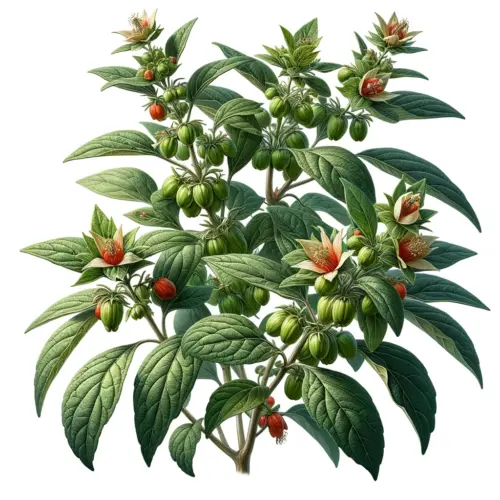
The plant is a short, woody shrub native to India, North Africa, and parts of the Mediterranean. It belongs to the Solanaceae family — the same family as tomatoes and peppers. However, herbalists prize the thick, starchy root most highly — that is where the majority of the active compounds concentrate.
The Sanskrit name means “smell of horse,” combining ashwa (horse) and gandha (smell). This reflects the root’s earthy scent. It also points to the traditional belief that the herb builds the strength and stamina of a horse.
Ashwagandha’s History and Origins
Traditional Ayurvedic practitioners classified ashwagandha as a Rasayana — a category of rejuvenating herbs for restoring vitality and supporting longevity. Furthermore, classical texts prescribed it after illness to rebuild depleted strength. Practitioners gave it to the young and old alike, reflecting its reputation as a broad tonic herb.
Today, herbalists continue to work with it for many of those same traditional uses. Modern science now provides additional context — and growing evidence — to support what Ayurvedic physicians observed for thousands of years.
Active Compounds in the Root
The root contains a group of naturally occurring steroidal compounds called withanolides. Researchers consider these the main drivers of ashwagandha’s adaptogenic effects. Additionally, the root contains alkaloids, saponins, and iron. Together, these compounds help the body respond to stress more effectively and recover from it more quickly.
Herbal Clinic includes ashwagandha root in its Non-Stimulating Adaptogen Blend — a calming formula featuring Holy Basil, Licorice, and Ligustrum for everyday stress support.
Key Health Benefits of Ashwagandha
Ashwagandha is now among the most clinically studied herbs in the adaptogen category. Most of the research focuses on four main areas: stress reduction, sleep support, physical performance, and cognitive function. Here is what the evidence currently shows.
Stress and Cortisol Reduction
One of ashwagandha’s best-documented effects is its ability to lower cortisol — the body’s primary stress hormone. A peer-reviewed study in the Indian Journal of Psychological Medicine tested a full-spectrum root extract against placebo. Adults in the herb group showed significantly lower cortisol levels. They also reported less perceived stress and anxiety. View the study on PubMed.
Here’s why that matters: chronically high cortisol disrupts sleep, weakens immunity, and affects metabolism. Therefore, by supporting healthy cortisol regulation, ashwagandha helps the body manage daily stressors more efficiently. For this reason, practitioners in both traditional and clinical herbalism regularly recommend it for stress support.
Sleep Quality and Relaxation
Research suggests the herb also supports sleep quality. Specifically, several trials found that participants who took ashwagandha root extract reported better sleep efficiency and faster sleep onset. Furthermore, morning alertness improved significantly in many participants. These effects appear most pronounced in people dealing with stress-related sleep disruption.
Physical Performance and Strength
Several clinical trials show that the herb can improve muscular strength and endurance. For example, one study in the Journal of the International Society of Sports Nutrition compared ashwagandha extract to placebo. Participants on the herb gained more strength in bench press and leg extension tests. Additionally, their VO2 max — a key measure of aerobic fitness — improved significantly. As a result, athletes and active adults increasingly turn to ashwagandha for natural recovery support.
Cognitive Function and Memory
Research also points to benefits for brain health. In particular, a randomised double-blind trial found improvements in reaction time, memory recall, and cognitive task performance in healthy adults after eight weeks of supplementation. Researchers attribute these effects partly to antioxidant activity in the root, which may protect neurons from oxidative damage over time.
Immune System Support
The withanolides in ashwagandha show anti-inflammatory and antioxidant activity in laboratory research. Traditional herbalists used the plant during recovery periods to support natural resilience. However, anyone with a diagnosed immune condition should consult a qualified health practitioner before starting any herbal supplement.
You can shop the Non-Stimulating Adaptogen Blend to add ashwagandha to your daily wellness routine in a convenient ready-made tincture.
How to Use Ashwagandha Tincture
A tincture is one of the most practical ways to use ashwagandha. Tinctures are concentrated liquid extracts made by soaking plant material in alcohol. The alcohol draws out the active compounds and preserves them — often for up to five years. Additionally, the liquid format absorbs quickly and is simple to measure and carry on the go.
What to Look for in Quality Ashwagandha Products
Not every ashwagandha product delivers the same results. When choosing a tincture, look for these key indicators of quality:
- Full-spectrum root extract — not leaf, or an unspecified plant part
- A clearly stated extraction ratio (1:5 or 1:2 are standard quality benchmarks)
- An alcohol percentage matched to the herb type — typically 30–50% for root material
- Third-party lab testing with certificates available on request
At Herbal Clinic, we make our ashwagandha tincture in a 1:5 ratio — one part herb to five parts solvent. We carefully control the alcohol percentage to suit the specific plant part. Furthermore, every batch undergoes third-party lab analysis and an organoleptic review by our herbalists in Toronto before bottling.
Want to understand the full process? Our beginner’s guide to making a herbal tincture walks through every step — from choosing your herb to bottling your finished extract.
Ashwagandha Side Effects and Precautions
The herb is generally well-tolerated by healthy adults. However, some people notice mild digestive discomfort when starting — most commonly nausea or an unsettled stomach. Taking the tincture with food usually reduces this. Start with a smaller amount and build up gradually if needed.
The following groups should speak with a healthcare practitioner before using ashwagandha or any other herbal supplement:
- Pregnant or breastfeeding women
- People with autoimmune conditions such as lupus, rheumatoid arthritis, or Hashimoto’s thyroiditis
- Those on immunosuppressant medications, sedatives, or thyroid hormone drugs
- People with nightshade sensitivity, since ashwagandha belongs to the Solanaceae family
These statements have not been evaluated by Health Canada. This product is not intended to diagnose, treat, cure, or prevent any disease.
Frequently Asked Questions
Superior Sourcing: Our herbs are sourced from all over the world to avoid seasonal fluctuations in availability, keeping herbs accessible. Our suppliers meet strict standards that ensure top quality herbs, most of which are organic, wildcrafted, sustainably grown, or grown using permaculture. We support local farmers and grow many of our own herbs. Superior Processing: Our tinctures are made using the classic tincturing method. The tinctures are made in a 1:5 ratio which allows for the optimal extraction of the herb. The alcohol percentage is strictly controlled depending on the herb and part of the plant that is used. Superior Selection: We take pride in our growing selection of over 300 individual herbs. If we don’t carry the herb you’re seeking, we can likely track it down for you. Superior Quality Control: Our tinctures are thoroughly tested by a third-party lab and with an organoleptic evaluation by our team of herbalists prior to final bottling. Superior Price: Our tinctures are more cost-effective than other tinctures on the market. With an eye towards efficiency, we keep our costs low by maintaining good relationships with our wide network of suppliers and ordering herbs in bulk quantities. We Care About the Environment: We repackage materials that are shipped to us. We recycle or reuse materials whenever possible. We turn the cardboard we receive from other suppliers into packing material. We donate to avoid waste to groups like Naturopaths Without Borders. Our workforce almost completely uses public transportation or bikes. We are powered using 100% renewable energy through Bullfrog Power. We Donate To Charity: We support many causes that make the world better. We donate a portion of our profits or products to charities that support environmental and natural sustainability.
Set up an online account and order through the website. If you don’t have an account and place an order, one will be created for you.
Click here to subscribe to our mailing list.
Our products are made in Toronto, Ontario, Canada by a team of Herbalists and Naturopathic Doctors. The herbs and ingredients we use to make our products are sourced both locally and globally to keep herbs accessible and sustainable.
The majority of our herbs are certified organic, sustainably wildcrafted, or come from small-scale local organic farms that do not yet have organic certification. We always do our best to provide organic herbs in your formulas. We work with a variety of suppliers to keep costs low.
Although most of our products do not contain gluten, we do not have gluten-free certification for our production facility. Feel free to ask about any specific products and we’ll share whatever information we have available.
For liability and regulatory reasons, we don’t make any claims as to how our herbs should be used, including dosing recommendations. Please review our disclaimer, as well as our terms and policies.